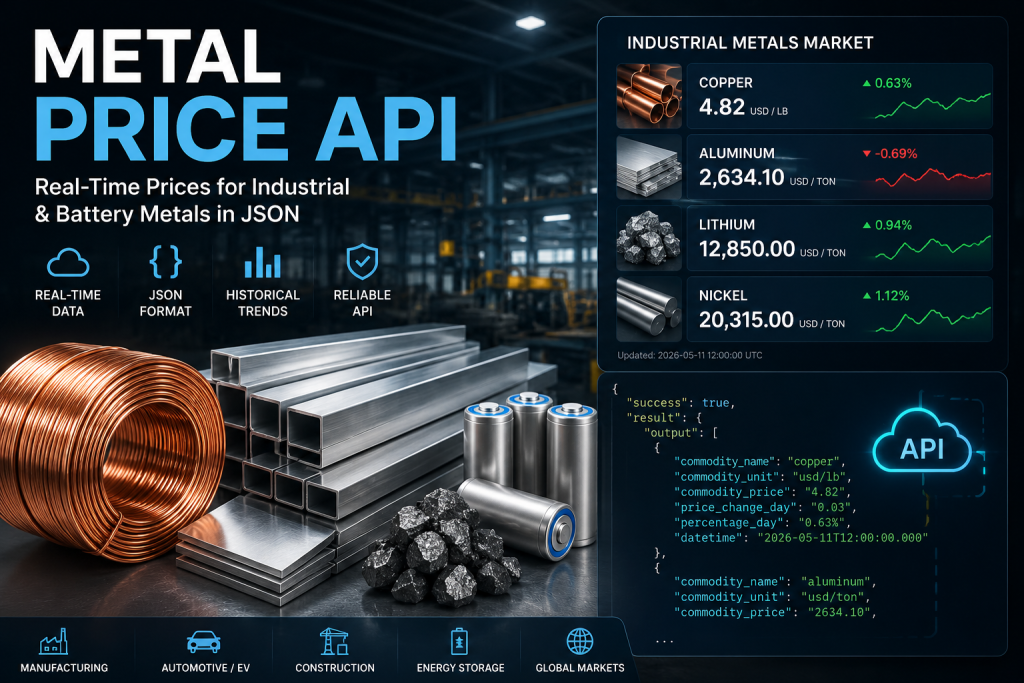
A metal price API provides structured access to real-time and historical metal price data, including copper, aluminum, lithium, nickel, steel, cobalt, and other industrial metals. These materials play a key role in manufacturing, construction, energy systems, electric vehicles, and global supply chains.
This guide explains how metal price data works, how it is structured in APIs, and how developers use it in industrial dashboards, commodity analytics, procurement systems, and financial applications.
In practice, metal price data is used to monitor market movements, compare industrial commodity prices, analyze supply chain risks, and track long-term demand across major metal markets.
Typical Industrial Metals Data Structure
Metal price data is usually delivered as structured JSON objects. Each record represents a single price snapshot for a specific metal or industrial commodity.
A typical metal price response includes the following parameters:
- commodity_name – metal or commodity identifier
- commodity_unit – measurement unit such as USD per ton, pound, or ounce
- commodity_price – latest quoted price
- price_change_day – daily price change
- percentage_day – daily percentage change
- percentage_week – weekly percentage change
- percentage_month – monthly percentage change
- percentage_year – yearly percentage change
- datetime – timestamp of the price update
This structure allows developers to compare multiple metals in one system, build price dashboards, and integrate industrial commodity data into business workflows.
Key Metals Covered by Metal Price APIs
Metal price APIs can cover a broad set of industrial, precious, and battery-related metals. The most common use cases focus on metals that affect manufacturing costs, infrastructure projects, and energy transition supply chains.
Copper
Copper prices are widely followed because copper is used in electrical wiring, construction, electronics, and renewable energy infrastructure. As a result, many analysts use copper as a signal for industrial demand.
Aluminum
Aluminum price data is important for transportation, packaging, aerospace, construction, and manufacturing. Because aluminum is lightweight and widely used, price changes can affect many industrial supply chains.
Lithium
Lithium is a critical battery metal used in electric vehicles, energy storage, and electronics. Therefore, lithium price data is especially important for EV, battery, and clean energy market analysis.
Nickel and Cobalt
Nickel and cobalt are also important battery metals. They are used in energy storage, stainless steel, and high-performance industrial materials.
Steel and Iron Ore
Steel and iron ore prices are closely connected to construction, manufacturing, infrastructure spending, and global industrial activity.
How Metal Price Data Is Used
Metal price data supports many industrial, financial, and operational workflows.
Manufacturing Cost Tracking
Manufacturers use metal prices to monitor raw material costs and adjust procurement plans. For example, changes in aluminum or steel prices can directly affect production budgets.
Battery Metals Analytics
Battery and EV companies track lithium, nickel, and cobalt prices to understand input costs, supply chain pressure, and long-term demand trends.
Commodity Trading and Research
Traders and analysts use copper, aluminum, and other metal prices to evaluate industrial momentum, inflation pressure, and commodity market trends.
Supply Chain Monitoring
Procurement teams and logistics platforms use metal price data to monitor cost volatility and prepare for changes in supplier pricing.
Example Metal Price Data Response
Below is an example of how multiple metal prices may appear in JSON format.
{
  "output": [
    {
      "commodity_name": "copper",
      "commodity_unit": "usd/lb",
      "commodity_price": "6.16",
      "price_change_day": "0.03",
      "percentage_day": "0.63%",
      "datetime": "2026-05-11T12:00:00.000"
    },
    {
      "commodity_name": "aluminum",
      "commodity_unit": "usd/ton",
      "commodity_price": "3596.15",
      "price_change_day": "-18.40",
      "percentage_day": "-0.69%",
      "datetime": "2026-05-11T12:00:00.000"
    },
    {
      "commodity_name": "lithium",
      "commodity_unit": "usd/ton",
      "commodity_price": "12850.00",
      "price_change_day": "120.00",
      "percentage_day": "0.94%",
      "datetime": "2026-05-11T12:00:00.000"
    }
  ]
}
Example Metal Data Request
To retrieve metal price data, you can send a simple API request. For example, the following request retrieves copper data:
https://apidata.fin2dev.com/v1/commodities?key=YOUR_API_KEY&commodity_name=copperExample API Integration
The following examples show how developers can request copper price data using Python and PHP.
Python Example
import requests

url = "https://apidata.fin2dev.com/v1/commodities"
params = {"key":"YOUR_API_KEY","commodity_name":"copper"}

data = requests.get(url, params=params).json()

print(data["result"]["output"])
PHP Example
<?php

$url = "https://apidata.fin2dev.com/v1/commodities?key=YOUR_API_KEY&commodity_name=copper";

$response = file_get_contents($url);
$data = json_decode($response, true);

print_r($data["result"]["output"]);

?>
Live Data Example
For example, a compact response from a metal price API may include the
output field with current price data for a selected metal.
{
  "output": [
    {
      "commodity_name": "copper",
      "commodity_unit": "usd/lbs",
      "commodity_price": "6.1602",
      "price_change_day": "0.03",
      "percentage_day": "0.63%",
      "percentage_week": "2.18%",
      "percentage_month": "4.91%",
      "percentage_year": "18.72%",
      "datetime": "2026-05-11T12:00:00.000"
    }
  ]
}
Start Using Metal Price API
Metal prices are available through the Fin2Dev Commodity Prices API, including Copper, Aluminum, Lithium, Nickel, Zinc and other industrial metals.
Start with a small plan for testing real-time and historical metal price data in JSON format.
Basic
- Metal price data via API
- 500 calls included
- 10 calls per minute
Metal Price API vs Commodity Price API
A metal price API focuses on industrial and metal-related commodities such as copper, aluminum, lithium, nickel, steel, cobalt, and other raw materials. Meanwhile, a broader Commodity Price API provides access to metals, energy, precious metals, agriculture, and other commodity markets.
If your application focuses only on metals, a metal-focused integration may be enough. However, for multi-asset systems, a full commodity API provides more flexibility.
Related Commodity APIs
Metal price data is often used alongside other commodity APIs to build broader market data platforms, procurement tools, and analytics systems.
- Gold Price API – access real-time gold price data and XAU market data
- Silver Price API – track silver price movements and XAG market data
- Oil Price API – monitor crude oil prices, WTI, and Brent market data
- Natural Gas Price API – access real-time natural gas prices and energy market data
- Agricultural Commodities Price API – access coffee, wheat, corn, soybean, sugar, and other agricultural commodity prices
- Commodity Price API – get unified access to metals, energy, agriculture, and global commodities data
Frequently Asked Questions
What is a metal price API?
A metal price API gives developers structured access to metal price data, including industrial metals such as copper, aluminum, lithium, nickel, cobalt, steel, and other raw materials.
Which metals can I track with an API?
Commonly tracked metals include copper, aluminum, lithium, nickel, cobalt, steel, iron ore, zinc, lead, and other industrial or battery-related metals.
Can I use metal price data for supply chain monitoring?
Yes, manufacturers, procurement teams, and analytics platforms use metal price data to monitor raw material costs, track volatility, and support supply chain decisions.
If you need access to multiple commodities including metals, energy, precious metals, agriculture, and industrial inputs, you can explore the full Commodity Price API.
Start Using Metal Price Data
Access real-time and historical metal price data via Fin2Dev APIs.
Explore Commodity Price API