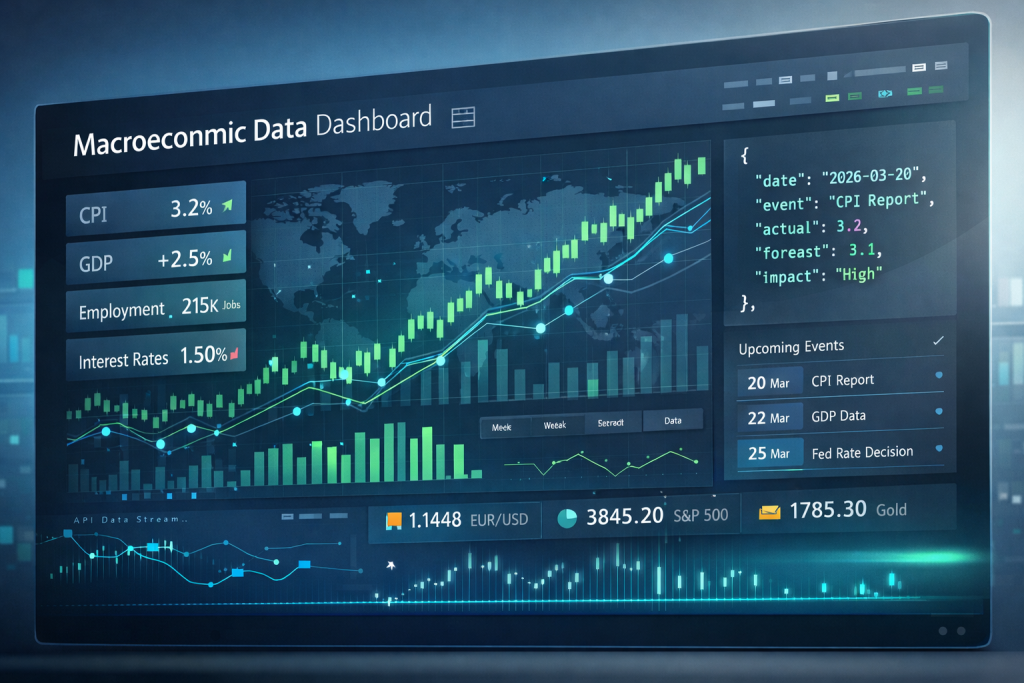
An economic calendar provides a structured view of upcoming macroeconomic events, including CPI releases, GDP reports, employment statistics, and central bank decisions. Each event is defined by a specific release time, country, and economic indicator.
This guide explains how economic calendar data works, including key release dates and how it is used in trading, analytics, and financial applications.
In practical applications, economic calendar data is used to monitor when key indicators are scheduled, filter events by country or importance, and trigger alerts or trading logic based on upcoming releases.
Typical Economic Calendar Data Structure
Economic calendar data is typically structured as a collection of standardized event objects, where each record represents a single macroeconomic release.
A typical economic calendar event includes the following parameters:
- datetime – scheduled release date and time
- country – country or economic region
- report_name – name of the economic indicator
- previous – value from the previous release
- consensus – market forecast or expected value
- actual – officially reported value
- unit – measurement unit (percent, index, etc.)
- impact – importance level of the event
This typical structure allows developers to consistently parse economic events, compare values, and integrate calendar data into trading systems, dashboards, and real-time analytics workflows.
Key Economic Indicators in the Calendar
A global economic calendar includes a wide range of macroeconomic indicators that reflect different aspects of economic performance.
Inflation Indicators
Inflation reports such as Consumer Price Index (CPI) and Producer Price Index (PPI) measure changes in price levels and purchasing power. These releases are closely watched because they influence monetary policy expectations and interest rate forecasts.
GDP (Economic Growth)
Gross Domestic Product (GDP) measures the total economic output of a country and is one of the main indicators used to assess economic growth, contraction, and long-term trends.
Employment Data
Employment indicators include Non-Farm Payrolls (NFP), unemployment rate, and wage growth. These reports provide insight into labor market strength, consumer demand, and inflation pressure.
Interest Rate Decisions
Central bank interest rate decisions affect borrowing costs, liquidity, inflation expectations, and currency valuation. These events are usually classified as high-impact releases in most economic calendars.
Other Important Indicators
- Retail sales
- Industrial production
- PMI and business activity reports
- Consumer confidence indexes
- Trade balance data
- Housing market indicators
Explore Individual Economic Indicators
Below are detailed guides covering some of the most important categories of economic releases tracked in a macroeconomic calendar.
CPI Release Dates
Learn how inflation data is scheduled, how CPI values are interpreted, and why inflation releases matter for financial markets.
GDP Release Dates
Understand GDP release schedules and how economic growth data affects currencies, equities, and macroeconomic analysis.
Employment Reports Calendar
Explore labor market data including Non-Farm Payrolls, unemployment rate, and wage growth releases.
Interest Rate Decisions Calendar
See how central bank rate decisions are scheduled and why they remain some of the most important economic calendar events.
Related Fin2Dev APIs
Fin2Dev provides structured access to macroeconomic releases and indicator data through dedicated API products designed for financial applications, dashboards, research workflows, and market monitoring tools.
- Macroeconomic Calendar API – access release dates, event times, actual values, previous values, consensus forecasts, and impact levels for economic events
- Macroeconomic Data API – access reported macroeconomic indicator values and time series data for analysis and charting
Both APIs are available under a single subscription, allowing you to combine scheduled economic events with historical macroeconomic indicator data in one integration.
Example Economic Calendar Data
Structured economic calendar data is widely used in trading systems, alerting tools, and financial analytics platforms. Below is an example of how an economic event may appear in JSON format.
{
          "datetime": "2026-03-20 12:30:00",
          "country": "United States",
          "report_name": "Consumer Price Index YoY",
          "actual": "3.2",
          "previous": "3.1",
          "consensus": "3.3",
          "unit": "percent",
          "impact": "3"
        }
Example Economic Calendar API Request
Below is an example request for retrieving economic events using an economic calendar API.
GET https://apidata.fin2dev.com/v1/macrocalendar?key=YOUR_API_KEY&country=United_StatesCommon Economic Indicators
| Indicator | Description | Impact Level |
|---|---|---|
| CPI (Consumer Price Index) | Measures inflation and changes in consumer prices | High |
| GDP (Gross Domestic Product) | Measures economic growth and total economic output | High |
| Non-Farm Payrolls (NFP) | Measures job creation in the United States | High |
| Interest Rate Decision | Central bank monetary policy decision | High |
| Retail Sales | Measures consumer spending activity | Medium |
| Industrial Production | Measures manufacturing and industrial output | Medium |
| Unemployment Rate | Measures the percentage of unemployed workers | High |
| PMI | Tracks business activity and economic momentum | Medium |
Global Economic Calendar Coverage
Economic calendar data typically includes events from major global economies, making it possible to monitor macroeconomic developments across regions and markets.
- United States (Fed, CPI, GDP, NFP, retail sales)
- Eurozone (ECB, inflation, GDP, PMI)
- United Kingdom (BoE, CPI, employment, retail sales)
- Canada (BoC, inflation, GDP, employment)
- Australia (RBA, CPI, retail sales, employment)
- Japan (BoJ, GDP, CPI, industrial production)
- China (GDP, industrial production, retail sales, PMIs)
This type of global coverage is especially useful for multi-asset trading, macro analysis, portfolio management, and international market monitoring.
Start Using the Economic Calendar API
Access real-time and historical macroeconomic events, including CPI, GDP, Non-Farm Payrolls, interest rate decisions, employment reports, retail sales, PMI releases, and more.
Start with a small plan, test real-time and historical economic calendar data in JSON format, then scale as your application grows.
Popular
- 3,000 calls included
- 20 calls per minute
Premium
- 10,000 calls included
- 30 calls per minute
Frequently Asked Questions
What data fields are included in an economic calendar?
A typical economic calendar event includes parameters such as datetime, country, report name, previous value, consensus (forecast), actual result, unit, and impact level. These fields allow developers to structure, display, and process economic events in applications.
Can I filter economic calendar events by country?
Yes, economic calendar data can be filtered by country. This allows developers to focus on specific markets, such as the United States, Eurozone, or Japan, and track only the most relevant economic events for their use case.
Which economic indicators are most important in a calendar?
The most important economic indicators typically include inflation data (CPI), GDP releases, employment reports such as Non-Farm Payrolls, unemployment rate, and central bank interest rate decisions. These events usually have the highest market impact and are closely monitored in trading systems and financial platforms.
How can I integrate economic calendar data into my system?
You can use the Fin2Dev Economic Calendar API to retrieve structured economic events and integrate them into your application, whether it’s a trading platform, financial dashboard, or alerting system.