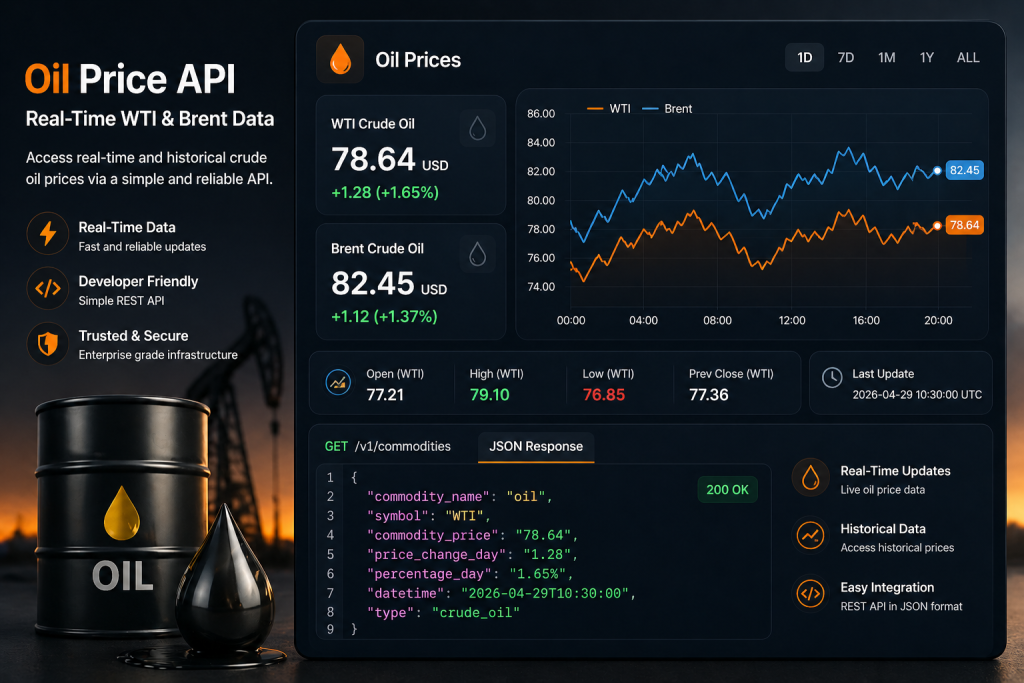
An oil price API gives developers direct access to real-time and historical crude oil prices, including WTI and Brent benchmarks. These prices play a key role in global markets, as oil strongly affects inflation, energy systems, and economic activity.
In this guide, you will learn how oil price data works, how APIs structure it, and how developers use it in trading systems, dashboards, and analytics platforms.
In practice, developers use oil price data to monitor market movements, build alerts, analyze trends, and integrate energy data into financial systems.
Typical Oil Price API Data Structure
Most APIs deliver oil price data as structured JSON objects. Each record represents a single price snapshot at a specific moment in time.
Typically, an oil price response includes the following parameters:
- commodity_name – identifies the commodity (oil)
- symbol – WTI or Brent benchmark
- commodity_price – current price
- price_change_day – daily price change
- percentage_day – daily percentage change
- datetime – timestamp of the price update
As a result, developers can easily integrate oil price data into applications, compare price movements, and build real-time monitoring tools.
WTI vs Brent Oil Prices
WTI (West Texas Intermediate) and Brent crude are the two main global oil benchmarks. However, they represent different markets and pricing structures.
WTI (West Texas Intermediate)
WTI serves as the main benchmark for U.S. oil pricing. It is widely used across North America and is known for its high quality. Because of this, many trading systems rely on WTI data.
Brent Crude
Brent crude acts as the global benchmark in international markets. It is commonly used in Europe, Asia, and the Middle East.
Therefore, most platforms track both WTI and Brent prices to understand global oil market dynamics.
How Oil Price Data Is Used
Oil price data supports a wide range of financial and analytical systems.
Energy Market Monitoring
First, analysts use oil prices to track supply and demand, geopolitical risks, and global energy trends.
Trading Platforms
In addition, trading platforms use real-time oil data for charting, order execution, and automated strategies.
Macroeconomic Analysis
Oil prices also influence inflation, currency movements, and economic indicators, making them essential for macro analysis.
Portfolio Management
Finally, investment platforms use oil data to track commodity exposure and balance multi-asset portfolios.
Example Oil Price Data
For example, the following JSON shows a typical oil price response:
{
  "commodity_name": "crude_oil",
  "symbol": "Brent",
  "commodity_price": "82.45",
  "price_change_day": "1.12",
  "percentage_day": "1.37%",
  "datetime": "2026-04-29T10:30:00"
}
Example Oil Price API Request
To retrieve crude oil price data, you can send a simple API request:
https://apidata.fin2dev.com/v1/commodities?key=YOUR_API_KEY&commodity_name=crude_oilExample API Integration
The following examples show how developers can request crude oil price data using Python and PHP.
Python Example
import requests

url = "https://apidata.fin2dev.com/v1/commodities"
params = {"key":"YOUR_API_KEY","commodity_name":"crude_oil"}

data = requests.get(url, params=params).json()

print(data["result"]["output"])
PHP Example
<?php

$url = "https://apidata.fin2dev.com/v1/commodities?key=YOUR_API_KEY&commodity_name=crude_oil";

$response = file_get_contents($url);
$data = json_decode($response, true);

print_r($data["result"]["output"]);

?>
Live Oil Price Data Example
For example, the following JSON shows a compact crude oil price response using the
output field from the API.
{
  "output": [
    {
      "commodity_name": "crude_oil",
      "commodity_unit": "usd/bbl",
      "commodity_price": "97.461",
      "price_change_day": "2.041",
      "percentage_day": "2.14%",
      "percentage_week": "-8.15%",
      "percentage_month": "-1.35%",
      "percentage_year": "57.78%",
      "datetime": "2026-05-11T12:30:00.000"
    }
  ]
}
Start Using Oil Price API
Oil is available through the Fin2Dev Commodity Prices API, together with Gold, Silver, Natural Gas, Copper, Lithium and more.
Start with a small plan, test real-time and historical oil price data in JSON format, then scale as your application grows.
Popular
- 3,000 calls included
- 20 calls per minute
Premium
- 10,000 calls included
- 30 calls per minute
Oil Price API vs Commodity Price API
A focused oil price API gives access to crude oil data. Meanwhile, a broader Commodity Price API covers multiple assets, including gold, silver, natural gas, and agricultural commodities.
For energy-specific applications, oil data alone may be enough. However, for multi-asset systems, a full commodity API provides more flexibility.
Related Commodity APIs
Oil price data often works together with other commodity APIs in comprehensive financial systems.
- Gold Price API – track gold prices (XAU)
- Silver Price API – monitor silver market data
- Natural Gas Price API – access real-time natural gas prices and energy market data
- Metal Price API – track copper, aluminum, lithium, and industrial metals
- Agricultural Commodities Price API – access coffee, wheat, corn, soybean, sugar, and other agricultural commodity prices
- Commodity Price API – access unified commodity data
Frequently Asked Questions
What is the difference between WTI and Brent?
WTI is the U.S. benchmark, while Brent is the global benchmark used in international markets.
How often is oil price data updated?
Oil price data is usually updated every few minutes, depending on the data provider.
Can I use oil price API data in real-time applications?
Yes, developers commonly use oil price APIs in trading platforms, dashboards, and analytics systems.
If you need access to multiple commodities including crude oil, gold, silver, natural gas, and industrial metals, you can explore the full Commodity Price API.
Start Using Oil Price Data
Access real-time and historical oil prices via Fin2Dev APIs.
Explore Commodity Price API