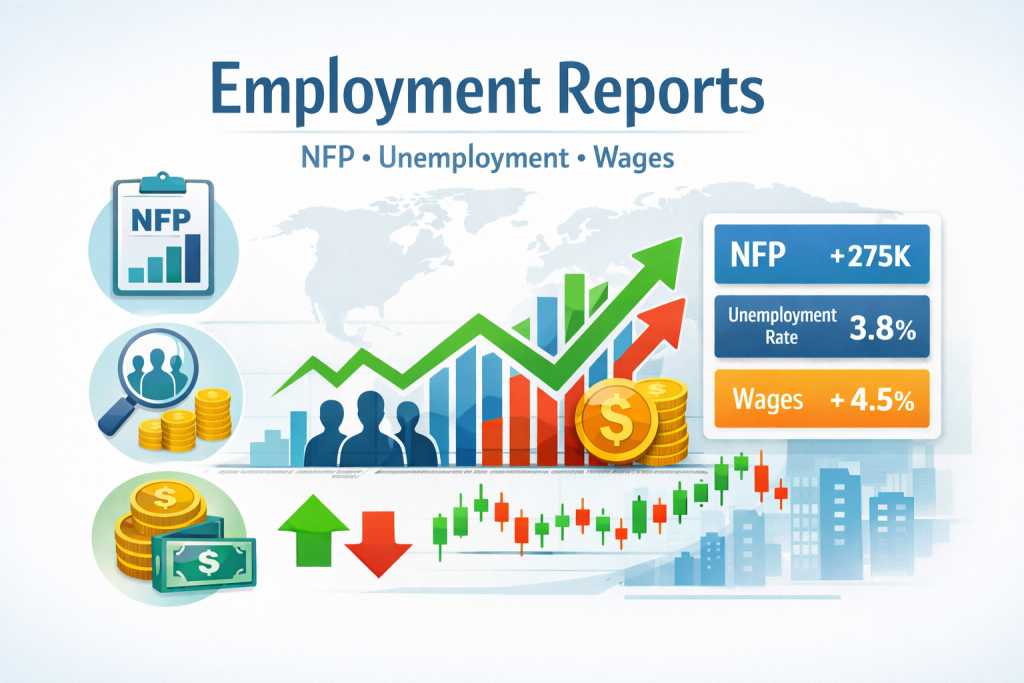
Employment reports are among the most important releases in the global economic calendar. They provide insight into labor market conditions, economic growth, and inflation pressure, making them essential for traders, analysts, and policymakers.
Market participants closely follow employment report calendars, including Non-Farm Payrolls (NFP), unemployment rate, and wage growth, as these indicators often drive volatility across currencies, equities, and bonds.
What Are Employment Reports?
Employment reports measure the health of a country’s labor market. They are typically released on a monthly basis by government statistical agencies.
The most closely watched employment indicators include:
- Non-Farm Payrolls (NFP) – number of jobs added or lost (excluding agriculture)
- Unemployment Rate – percentage of the labor force that is unemployed
- Average Hourly Earnings – a key indicator of wage growth and inflation pressure
Because employment data reflects real economic activity, it is considered one of the most impactful macroeconomic indicators.
Why Employment Reports Matter
Employment data plays a crucial role in financial markets and monetary policy decisions. Strong labor market data may signal economic expansion and inflation risks, while weaker data may indicate slowing growth or recession concerns.
Employment indicators are especially important when analyzed alongside GDP, inflation, and central bank interest rate decisions.
| Field | Description |
|---|---|
| Actual | The value published in the latest employment report |
| Previous | The value from the prior release period |
| Consensus | The market expectation before publication |
| Impact | Expected market importance of the event |
Example Employment Report Data
Structured employment calendar data is widely used in trading systems, economic dashboards, and financial analytics platforms. Below is an example of how an employment report event may appear in JSON format.
{
          "datetime": "2026-04-04 12:30:00",
          "country": "United States",
          "report_name": "Non-Farm Payrolls",
          "actual": "275000",
          "previous": "229000",
          "consensus": "200000",
          "unit": "Jobs",
          "impact": "3"
        },
        {
          "datetime": "2026-04-04 12:30:00",
          "country": "United States",
          "report_name": "Unemployment Rate",
          "actual": "3.8",
          "previous": "3.9",
          "consensus": "3.8",
          "unit": "Percent",
          "impact": "3"
        },
        {
          "datetime": "2026-04-04 12:30:00",
          "country": "United States",
          "report_name": "Average Hourly Earnings",
          "actual": "0.4",
          "previous": "0.3",
          "consensus": "0.3",
          "unit": "Percent",
          "impact": "3"
}
Example Macroeconomic Calendar API Request
Below is an example request for retrieving employment report events using the Fin2Dev API.
Example shown for United States (country parameter: United_States).
GET https://apidata.fin2dev.com/v1/macrocalendar?key=YOUR_API_KEY&country=United_StatesExample JSON response fragment:
{
  "datetime": "2026-04-04 12:30:00",
  "iso_country_code": "US",
  "country": "United States",
  "report_name": "Unemployment Rate",
  "report_date": "Mar",
  "actual": "3.8",
  "previous": "3.9",
  "consensus": "3.8",
  "unit": "Percent",
  "impact": "3"
}
Example Macroeconomic Data API Request
Historical employment data allows developers to track labor market trends over time, build forecasting models, and create economic research tools.
Example shown for United States (country parameter: United_States).
GET https://apidata.fin2dev.com/v1/macroindicator?key=YOUR_API_KEY&country=United_StatesExample JSON response fragment:
{
  "report_name": "Unemployment Rate",
  "previous": "3.7",
  "actual": "3.8",
  "unit": "Percent",
  "report_date": "2026-03"
}
How Developers Use Employment Data
Developers use employment data to power economic calendars, trading dashboards, analytics tools, and automated alert systems.
- Fetch upcoming employment events from the economic calendar
- Display release time, previous values, and market consensus
- Monitor the release of NFP, unemployment, and wage data
- Update dashboards, alerts, or trading models with actual values
Access Employment Data via API
Developers and fintech platforms can access structured employment report data using the Fin2Dev Macroeconomic Calendar API.
Historical employment indicators can also be integrated through the Fin2Dev Macroeconomic Data API, enabling long-term analysis of labor market trends.
This allows teams to automatically track employment releases, analyze labor market conditions, and integrate employment data into financial applications.
Related Articles
Explore Related APIs
Looking to integrate employment data and macroeconomic indicators into your application?
Access Employment Data via API
Retrieve NFP, unemployment rate, and wage data using structured Fin2Dev APIs.
Get API Access