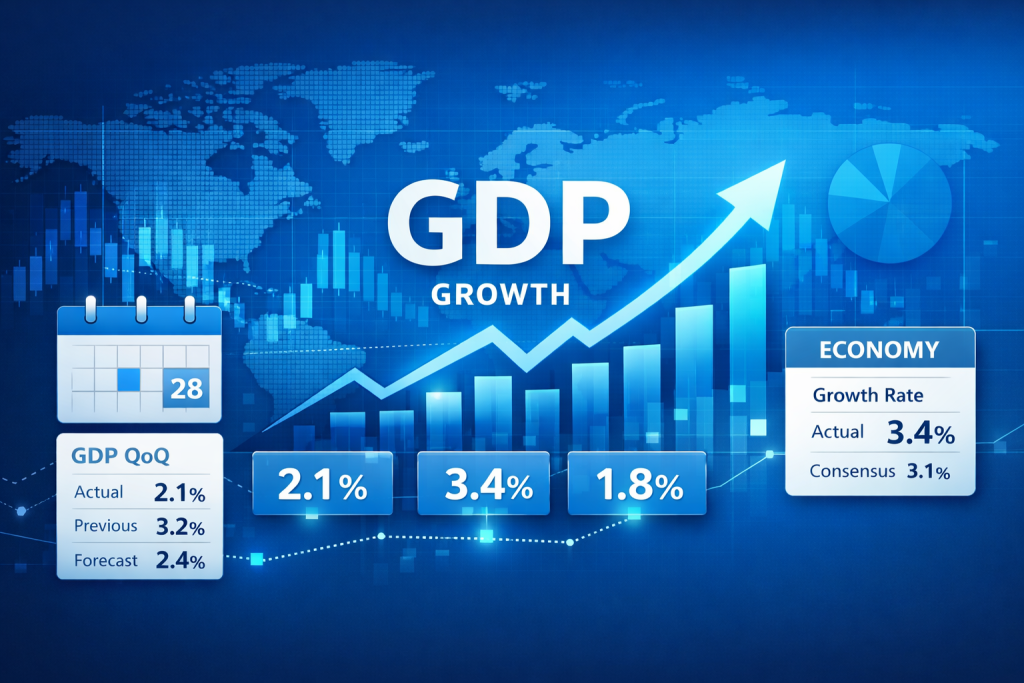
GDP releases are among the most closely watched events in the global economic calendar. Gross Domestic Product (GDP) measures the total value of goods and services produced in an economy and is one of the main indicators used to evaluate economic growth.
Traders, analysts, and fintech platforms monitor GDP release calendars because GDP data can influence equities, bonds, currencies, commodities, and expectations about future monetary policy.
What Is GDP?
GDP stands for Gross Domestic Product. It reflects the overall economic output of a country over a defined period and is widely used to measure the size and growth rate of an economy.
GDP data is commonly analyzed to:
- Measure economic growth
- Compare performance across countries
- Evaluate business cycle trends
- Support investment and policy analysis
Because GDP is considered a broad measure of economic activity, its release is often treated as a high-impact macroeconomic event.
Why GDP Releases Matter
GDP releases help market participants understand whether an economy is expanding, slowing down, or contracting. Stronger-than-expected GDP growth may support risk assets and strengthen a currency, while weaker results may increase recession concerns and influence interest rate expectations.
GDP data is especially important when analyzed together with inflation, employment, retail sales, and central bank policy decisions.
| Field | Description |
|---|---|
| Actual | The GDP value published in the latest release |
| Previous | The GDP value from the prior release period |
| Consensus | The market expectation before publication |
| Impact | Expected market importance of the event |
Example GDP Release Data
Structured GDP calendar data is useful for economic dashboards, financial research tools, market alert systems, and event-driven trading workflows. Below is an example of how a GDP release event may appear in JSON format.
[
  {
    "datetime": "2026-04-30 12:30:00",
    "country": "United States",
    "report_name": "GDP QoQ Annualized",
    "actual": "2.1",
    "previous": "2.4",
    "consensus": "2.3",
    "unit": "Percent",
    "impact": "3"
  },
  {
    "datetime": "2026-04-30 12:30:00",
    "country": "United States",
    "report_name": "GDP Price Index QoQ",
    "actual": "3.2",
    "previous": "2.9",
    "consensus": "3.0",
    "unit": "Percent",
    "impact": "2"
  },
  {
    "datetime": "2026-04-30 12:30:00",
    "country": "United States",
    "report_name": "GDP Deflator QoQ",
    "actual": "3.1",
    "previous": "2.8",
    "consensus": "3.0",
    "unit": "Percent",
    "impact": "2"
  },
  {
    "datetime": "2026-04-30 12:30:00",
    "country": "United States",
    "report_name": "GDP YoY",
    "actual": "2.5",
    "previous": "2.7",
    "consensus": "2.6",
    "unit": "Percent",
    "impact": "3"
  },
  {
    "datetime": "2026-04-30 12:30:00",
    "country": "United States",
    "report_name": "Real GDP QoQ",
    "actual": "2.0",
    "previous": "2.3",
    "consensus": "2.2",
    "unit": "Percent",
    "impact": "3"
  },
  {
    "datetime": "2026-04-30 12:30:00",
    "country": "United States",
    "report_name": "GDP Growth Rate",
    "actual": "2.1",
    "previous": "2.4",
    "consensus": "2.3",
    "unit": "Percent",
    "impact": "3"
  }
]
Example Macroeconomic Calendar API Request
Below is an example request for retrieving GDP release events using the Fin2Dev API.
Example shown for United States (country parameter: United_States).
GET https://apidata.fin2dev.com/v1/macroindicator?key=YOUR_API_KEY&country=United_States&date=2025-06-26Example JSON response fragment:
{
  "datetime": "2025-06-26 12:30:00",
  "iso_country_code": "US",
  "country": "United States",
  "report_name": "GDP Growth Rate QoQ Final",
  "report_date": "Q1",
  "actual": "-0.2",
  "previous": "2.4",
  "consensus": "-0.2",
  "unit": "percent",
  "impact": "3"
}
Example Macroeconomic Data API Request
Historical GDP datasets make it possible to track economic growth over time. This is useful for macro research, charting, forecasting models, and country comparison tools.
Example shown for United States (country parameter: United_States).
GET https://apidata.fin2dev.com/v1/macroeconomic?key=YOUR_API_KEY&country=United_StatesExample JSON response fragment:
{
  "report_name": "GDP Growth Rate",
  "previous": "0.7",
  "actual": "4.4",
  "unit": "Percent",
  "report_date": "2025-12"
}
How Developers Use GDP Data
Developers use GDP data to power macroeconomic calendars, country dashboards, research platforms, screening tools, and automated market monitoring systems.
- Fetch upcoming GDP release events from the economic calendar
- Display release time, previous value, and market consensus
- Monitor the event when the official GDP figure is published
- Update dashboards, alerts, or models with the actual released value
Access GDP Data via API
Developers and fintech platforms can access structured GDP event data using the Fin2Dev Macroeconomic Calendar API.
Historical GDP values can also be integrated through the Fin2Dev Macroeconomic Data API, making it easier to build charts, research tools, and long-term economic trend analysis systems.
This allows teams to automatically track GDP releases, compare economic growth across countries, and integrate GDP data into financial applications.
Related Articles
Explore Related APIs
Looking to integrate GDP growth data and macroeconomic indicators into your application?
Access GDP Data via API
Retrieve GDP release dates, economic growth indicators, and historical macroeconomic data using Fin2Dev APIs.
Get API Access